Baby Gear
Convertible vs. Infant vs. All-in-One Car Seats: Lifespan Cost
The type of car seat you start with shapes your budget for the next six years. Here is the total-cost-of-ownership math — and the safety nuances that matter more than the sticker price.
Clinically reviewed · June 2026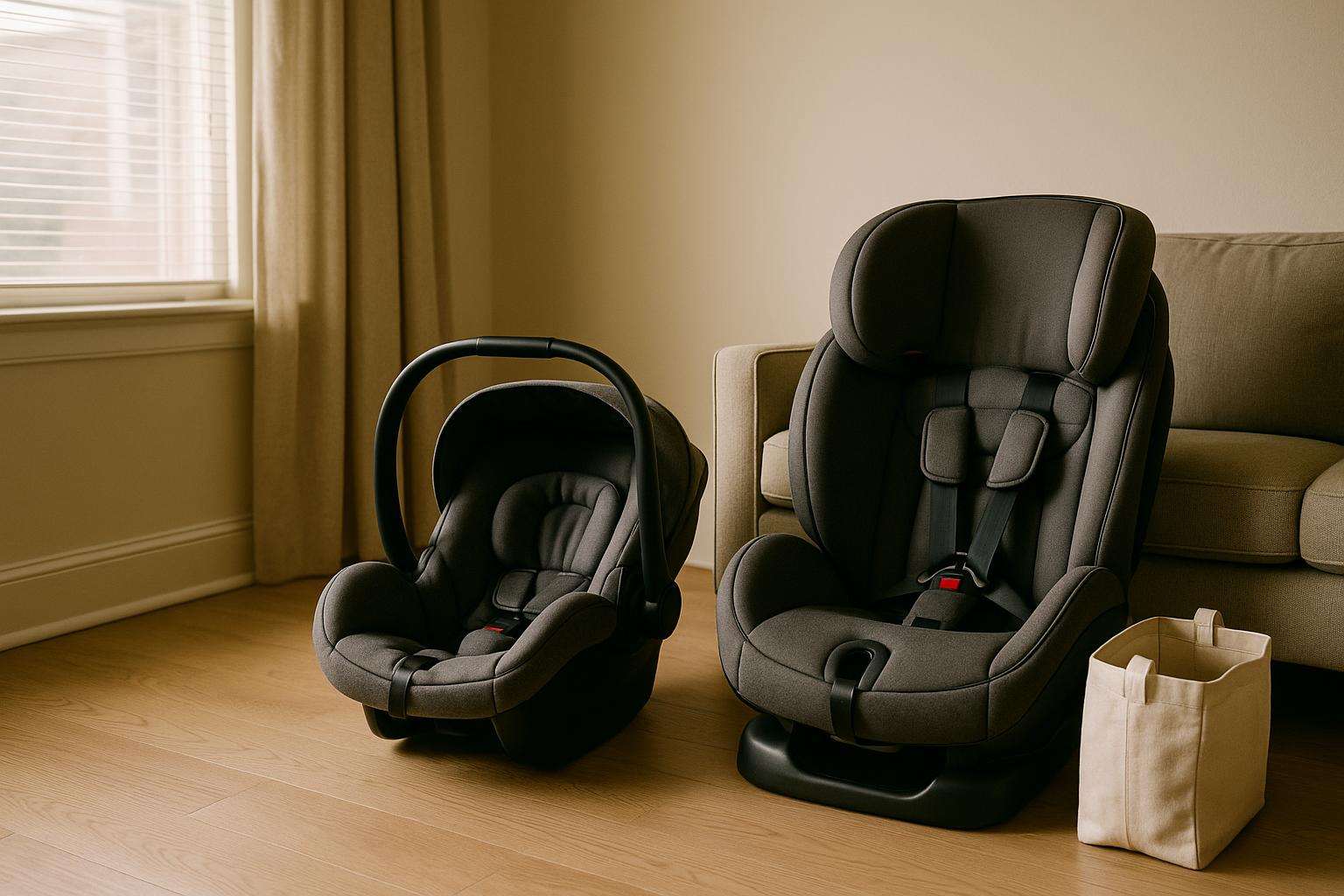
An all-in-one seat like the Graco 4Ever DLX (~$300) is the most cost-efficient single-purchase option, covering rear-facing infant through booster at roughly $30 per year over its 10-year lifespan. An infant seat plus separate convertible gives better newborn fit but typically costs $780–$930 over six years — and spending more does not reliably mean safer.
One of the first purchases expectant parents research — and one of the most confusing — is the car seat. The market offers three distinct category types, each with a different lifespan, a different price point, and a different relationship between cost and safety performance. As a certified child passenger safety technician (CPST), I work through this decision with families every week. Here is the real breakdown.
What Is the Difference Between an Infant Seat, a Convertible Seat, and an All-in-One?
Infant-only seats (also called infant carriers or infant carrier car seats) are designed exclusively for rear-facing use, typically accommodating a child from 4 lbs up to 30–35 lbs depending on the model. The defining feature is portability: the carrier detaches from its base and snaps into compatible strollers, forming what is called a travel system. This click-in, click-out convenience is genuinely useful in the first months — you can move a sleeping baby from car to stroller without disturbing them. The trade-off is that once your baby reaches the weight or height limit, you buy a second seat.
Top infant seat picks tested by BabyGearLab in 2025–2026 include the Nuna Pipa RX (9.0/10 crash score, ~$550, 4–32 lbs), the Chicco KeyFit 35 (strong usability, ~$249, 4–35 lbs), the UPPAbaby Mesa V3 (~$399.99, GREENGUARD Gold certified, but 5.1/10 crash score in commissioned testing), and the budget-friendly Graco SnugRide (~$140–$260).
Convertible seats begin rear-facing for newborns and transition to forward-facing when age, weight, and height allow — but they do not convert to a booster seat. They are permanently installed in the vehicle (no detachable carrier) and are larger and heavier than infant seats. They typically last 8–10 years. The Nuna Rava is the top-rated convertible in independent testing, earning an overall score of 84/100 from BabyGearLab: 8.5/10 on crash testing and 9.0/10 for ease of use. It supports 5–50 lbs rear-facing and 30–65 lbs forward-facing, uses bamboo/polyester fabric free of added flame retardants, and holds GREENGUARD Gold certification. Retail is approximately $499–$580.
All-in-one seats (also called 3-in-1 or 4-in-1 seats) cover rear-facing infant use, forward-facing use with harness, and belt-positioning booster use in a single product. They are the most cost-efficient single-purchase option in theory — one seat from birth through roughly age 10 — but they are also the largest and heaviest seats on the market, which can create installation challenges and three-across limitations in smaller vehicles.
How Does the Total Cost of Ownership Actually Compare?
The arithmetic is more revealing than the sticker price alone. Here is a realistic comparison across the three paths.
| Path | Example Seats | Approx. Total Spend | Lifespan Coverage | Cost Per Year | Key Trade-Off |
|---|---|---|---|---|---|
| Infant seat + convertible + booster | Chicco KeyFit 35 + Nuna Rava + belt-positioning booster | $780–$930 | Birth through ~age 8–10 | ~$90–$115/yr | Best fit at each stage; highest total spend; two installs |
| Infant seat + all-in-one | Graco SnugRide + Graco 4Ever DLX | ~$440–$560 | Birth through ~age 10 | ~$45–$57/yr | Good fit in infancy; moderate savings; two seats total |
| All-in-one from birth | Graco 4Ever DLX | ~$300 | Birth through ~age 10 | ~$30/yr | Lowest total cost; bulkier in infancy; no carrier portability |
| Convertible from birth + booster | Nuna Rava + belt-positioning booster | ~$530–$680 | Birth through ~age 8–10 | ~$55–$70/yr | Best crash/ease scores; no portability; still needs a booster |
The Graco 4Ever DLX earns particular attention here. At approximately $299.99 and a 10-year lifespan, it costs about $30 per year — and it earned the best crash-test score in its category at 8.7/10 in BabyGearLab's commissioned testing. Its rear-facing range runs 4–40 lbs, forward-facing with harness up to 65 lbs, and as a booster up to 120 lbs. The main practical limitation is its width of 19.3 inches, which can complicate three-across seating in mid-size vehicles.
The Britax One4Life ClickTight at $350–$440 offers the easiest seatbelt installation of any all-in-one seat (installation ease score: 8.0/10) and a rear-facing limit up to 50 lbs with a 15-position no-rethread harness. But its crash-test performance of 6.7/10 trails the Graco's 8.7 — a clear reminder that a higher price does not guarantee superior safety performance. The One4Life Slim variant, at $449.99, narrows the width to 17.5 inches, making genuine three-across use achievable in most full-size vehicles.
All seats sold in the U.S. must meet FMVSS 213 — the federal safety floor is the same regardless of price. Above that floor, crash performance does not track reliably with cost. Always check independent crash-test scores, not just marketing claims.
When Does an Infant Seat Make Sense Despite the Extra Cost?
For all the cost-efficiency advantages of the all-in-one path, there are genuine situations where starting with an infant carrier is the better choice.
Premature or small-for-gestational-age newborns. Infant carriers accommodate babies as small as 4 lbs (some NICU-specific seats go lower), and their smaller shell dimensions provide a better fit for very small infants who would rattle around in the larger shell of an all-in-one seat. A NICU care team will specify seat requirements before discharge.
Families who rely heavily on a stroller travel system. The click-in portability of an infant carrier — snapping from base to stroller in one motion without waking a sleeping baby — has real daily utility for parents who walk, use public transit, or rotate between multiple caregivers and vehicles. This convenience disappears entirely with a convertible or all-in-one seat.
Multiple vehicles. If a baby regularly travels in two vehicles (both parents drive, or grandparents share childcare), buying an extra base (~$80–$130) is significantly cheaper than purchasing a second all-in-one seat. Most infant carrier bases are sold separately and allow the same carrier to move quickly between vehicles.
When you already have a compatible stroller. If you have invested in an UPPAbaby Vista or Cruz, the Mesa V3 integrates without adapters. If you own a Chicco stroller, the KeyFit 35 clicks in natively. Stroller compatibility is a legitimate factor in the first-year equation — but confirm the match before purchasing, as compatibility is brand- and model-specific.
What About Materials and Chemical Safety?
Crash performance is the primary factor in any car seat decision. But parents of newborns and infants often ask about a secondary concern: chemical flame retardants in seat foam and fabric. It is a legitimate question, not a fringe one.
To meet the federal flammability standard FMVSS 302, most car seat foams have historically been treated with chemical flame retardants. A 2024 study published in Environmental Science & Technology detected organophosphate ester flame retardants in 99% of vehicles tested, with concentrations rising up to nine-fold in summer heat as seat foam off-gases into enclosed cabin air. The National Toxicology Program found evidence of carcinogenic activity in animals exposed to TCIPP, one of the most common organophosphate replacements.
Several manufacturers now meet federal flammability requirements without adding chemical flame retardants. Nuna is the only major brand where every model is flame retardant-free, using inherently resistant fabrics and holding GREENGUARD Gold certification across its line. Chicco's ClearTex models and the UPPAbaby Mesa V3 are also marketed as flame retardant-free and GREENGUARD Gold certified. Brands that do not currently offer any flame retardant-free models include Safety 1st, Cosco, Baby Trend, and Doona.
Practical steps to reduce exposure regardless of seat brand: avoid leaving seats in a hot, enclosed car when not in use (heat accelerates off-gassing), vacuum the seat surface regularly, and wash hands after handling the seat. Materials considerations should inform your decision — but never at the cost of choosing a seat with lower crash-test performance or a poor fit.
This article provides general product and safety information, not personalized medical or safety advice. For hands-on installation guidance and a fit check specific to your vehicle, book an appointment with a Certified Child Passenger Safety Technician (CPST) through the NHTSA inspection station locator — the service is free.
Frequently asked
Is a convertible car seat safe from birth?
Yes — a convertible seat is safe for a newborn when the infant meets the seat's minimum weight requirement (typically 4–5 lbs for most models) and the harness fits snugly with the chest clip at armpit level. The trade-off is that convertible seats are bulkier and cannot be unclipped and carried into a building the way an infant carrier can. For families with a full-term baby of average size, a convertible seat from birth is a perfectly safe choice endorsed by the American Academy of Pediatrics. Families expecting a premature or very small baby should confirm the seat's minimum weight limit before purchasing, and consult the NICU team before discharge on appropriate fit.
What is the real cost difference between an infant seat plus convertible versus an all-in-one?
The math depends on which models you choose, but here is a realistic range. An infant seat (e.g., Chicco KeyFit 35 at ~$249) plus a separate convertible (e.g., Nuna Rava at ~$499–$580, plus a future booster at $30–$100) puts your total spend at roughly $780–$930 over about six years. An all-in-one such as the Graco 4Ever DLX at ~$300 covers rear-facing infant through booster in a single purchase — roughly $300 over ten years, or about $30 per year. The dual-seat path costs more upfront but delivers the best fit for a small newborn; the all-in-one path saves the most money and reduces the number of installs and transitions.
Does spending more on a car seat mean it is safer?
Not reliably — and this is one of the most important things I tell every parent I work with. BabyGearLab's commissioned crash testing found that the Britax One4Life ClickTight (priced at $350–$440) scored only 6.7 out of 10 in crash performance, while the Graco 4Ever DLX (at ~$300) scored 8.7 out of 10 — the best in its category. The Nuna Rava (~$499–$580) earns the top overall score of 84/100 for convertibles, but also requires a future booster purchase. All seats sold in the United States must meet the federal FMVSS 213 safety minimum, so the floor is the same across price points; above that floor, crash-test performance does not track neatly with price.
How long does each type of car seat last?
Expiration dates are set by manufacturers based on how petroleum-based plastics degrade under heat cycling, UV exposure, and physical stress. General industry norms are 6 years for infant carriers, 8 years for convertible seats, and up to 10 years for all-in-one and booster seats. The expiration date is measured from the manufacture date (printed on a label on the seat's underside) — not the purchase date. A seat that sat on a store shelf for a year is already one year closer to expiration before you install it for the first time. SafeRide4Kids notes that NHTSA recommends following the manufacturer's guidance and advises against using any seat past its expiration date regardless of visual condition.
Can I fit three car seats across the back seat of my vehicle?
It depends entirely on your vehicle's interior width and the specific seats you choose. All-in-one and convertible seats are typically wider than infant carriers. The Britax One4Life Slim (17.5 inches wide) is specifically designed to allow three-across placement in most full-size sedans and SUVs; the standard One4Life measures 19.4 inches and fits three-across only in larger vehicles. The Graco 4Ever DLX is 19.3 inches wide and may be challenging in mid-size vehicles. Infant seats mounted in their bases generally range from 16 to 18 inches wide. Before purchasing any seat for a three-across configuration, Car Seats For The Littles maintains a database of vehicle-specific three-across compatibility reports you can consult.
What is the best all-in-one car seat for most families?
For most families, the Graco 4Ever DLX is the top all-in-one pick on a combination of crash-test performance and value. It earned an 8.7/10 in BabyGearLab's commissioned crash testing — the highest score in the all-in-one category — at a retail price of approximately $299.99, which works out to about $30 per year over its 10-year lifespan. It covers 4–40 lbs rear-facing, up to 65 lbs forward-facing with harness, and up to 120 lbs as a belt-positioning booster. Its main trade-off is width (19.3 inches), which can limit three-across use. Families who prioritize ease of installation may prefer the Britax One4Life ClickTight, though at a lower crash-test score for a higher price.
Should I be concerned about flame retardants in car seats?
It is a reasonable question — and one worth weighing alongside crash performance, not instead of it. Most car seat foams have historically been treated with chemical flame retardants to meet the federal FMVSS 302 flammability standard. A 2024 study in Environmental Science & Technology detected organophosphate ester flame retardants in 99% of vehicles tested, with concentrations rising up to nine-fold in summer heat. Nuna is currently the only major brand where every model is flame retardant-free, holding GREENGUARD Gold certification across its line. Chicco's ClearTex models and the UPPAbaby Mesa V3 are also marketed as flame retardant-free and GREENGUARD Gold certified. The safest seat remains one that fits correctly, installs correctly, and passes crash testing — materials considerations should inform but not override that priority.